Comparing Agile Billing Software by Agility and Complexity
Modern billing environments increasingly combine subscriptions, usage and consumption pricing, tiered structures, multiple sales channels, geographic requirements, and hybrid digital and physical products.
Supporting that complexity is only part of the challenge. Organizations also need to introduce new pricing, packaging, products, and monetization strategies without lengthy implementation cycles or excessive operational effort.
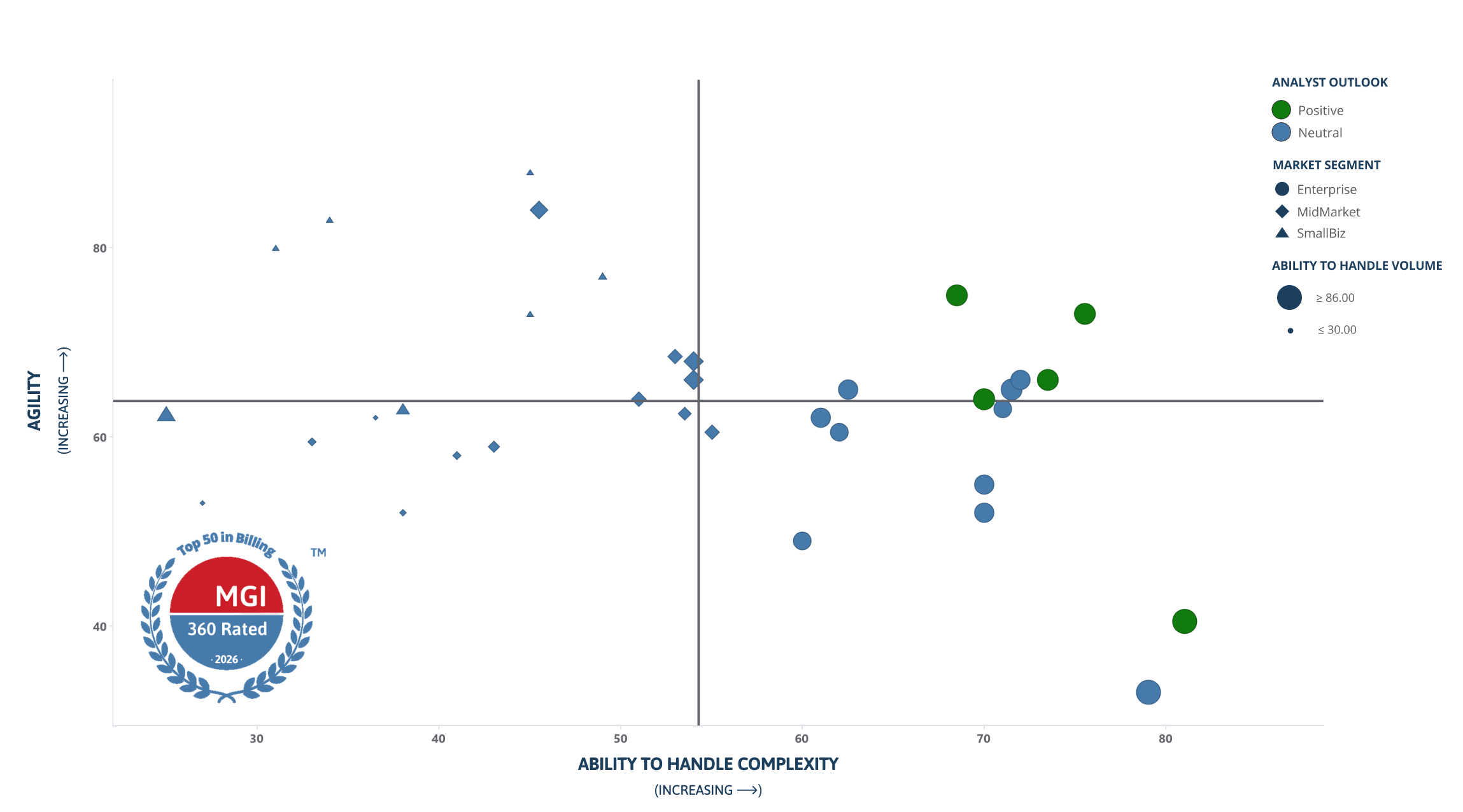
The MGI MarketLens™: Agility vs. Complexity compares MGI 360 Rated™ Agile Billing solutions across these two dimensions. Billing Agility measures how readily a solution can accommodate change, while Billing Complexity measures the range of sophisticated billing requirements it can support. Together, the two measures help buyers understand a critical consideration in billing software selection: how much complexity can a solution support while remaining adaptable to changing business requirements?
Why Agility and Complexity Matter
Billing requirements are becoming more sophisticated as organizations combine recurring, usage-based, consumption, and hybrid pricing models across products, channels, markets, and geographies.
At the same time, organizations need to change pricing, packaging, and monetization strategies quickly. A billing platform that supports complex requirements but is difficult to modify can constrain the business. A highly agile platform may be easier to deploy and operate but may not support the most demanding enterprise billing scenarios.
MGI Research’s 2026 analysis suggests that this tradeoff is becoming less pronounced. A number of Enterprise-focused suppliers combine substantial billing complexity with average or above-average agility, while many SmallBiz and MidMarket solutions continue to emphasize ease of deployment and rapid change over the highest levels of complexity.
What Is Billing Agility?
Billing Agility describes how readily a billing solution can accommodate changes to pricing, packaging, products, and business requirements.
MGI Research evaluates agility across three primary dimensions:
- Business Agility: how quickly organizations can configure pricing, business rules, discounts, currencies, taxes, and related requirements.
- IT Agility: the time and technical resources required to install, configure, test, deploy, monitor, and maintain the solution.
- Product Agility: how quickly an organization can change product catalogs, pricing, and product or service components.
Agility is especially important for organizations operating in rapidly changing markets or frequently introducing new monetization strategies.
What Is Billing Complexity?
Billing Complexity represents the range of pricing, packaging, sales, operational, and regulatory requirements that a billing platform can support.
MGI Research considers factors including product and pricing complexity, billing and metering attributes, sales channels, payment methods, geographic requirements, regulatory requirements, and the pace of change within the business.
Complex use cases can include usage-based billing, prepaid and post-paid models, tiered pricing, product bundles, multi-entity operations, international invoicing, multiple currencies, and regulated environments.
What the 2026 MarketLens™ Shows
The 2026 analysis demonstrates that the most agile billing platforms and the platforms supporting the greatest billing complexity are not necessarily the same.
SAP, Oracle, and BillingPlatform receive the three highest Billing Complexity scores, while JustOn, Recurly, and Zoho receive the three highest Billing Agility scores.
The analysis also highlights differences by market segment. SmallBiz providers such as JustOn, Recurly, and Zoho emphasize agility and relatively low operational overhead, while a considerable number of Enterprise suppliers combine high complexity with average or above-average agility.
| Key Insight: Supporting sophisticated billing requirements increasingly does not require the same degree of sacrifice in agility. Buyers should evaluate where their organization sits on both dimensions rather than treating agility and complexity as mutually exclusive requirements. |
What Should Buyers Evaluate?
Organizations emphasizing Agility should consider how frequently pricing and packaging change, how quickly new monetization strategies must launch, and how many business and IT resources are available to operate the billing environment.
Organizations emphasizing Complexity should consider requirements such as usage and consumption pricing, hybrid physical and digital products, sophisticated pricing models, multiple sales channels, international operations, regulatory requirements, and multi-currency or multi-jurisdiction invoicing.
The appropriate position on the MarketLens™ depends on the organization’s current requirements, expected evolution, resources, and monetization strategy.
Explore the 2026 Agile Billing MarketLens™ Series
The 2026 Agile Billing research includes four complementary MarketLens™ analyses:
- Go-to-Market Strength vs. Solution Strength
- Agility vs. Complexity
- Volume vs. Agility
- Complexity vs. Volume
Together, they provide different perspectives on vendor and solution fit within the Agile Billing market.
Get the Full Agility vs. Complexity MarketLens™
The full MGI MarketLens™: Agility vs. Complexity includes the complete 2026 vendor positioning chart and supporting analysis.