Comparing Billing Software by Complexity and Volume
Billing requirements vary significantly by organization. Some businesses prioritize straightforward recurring revenue models with relatively modest transaction volumes. Others need to support usage-based pricing, sophisticated product structures, multiple entities and geographies, regulatory requirements, or very large flows of billing events.
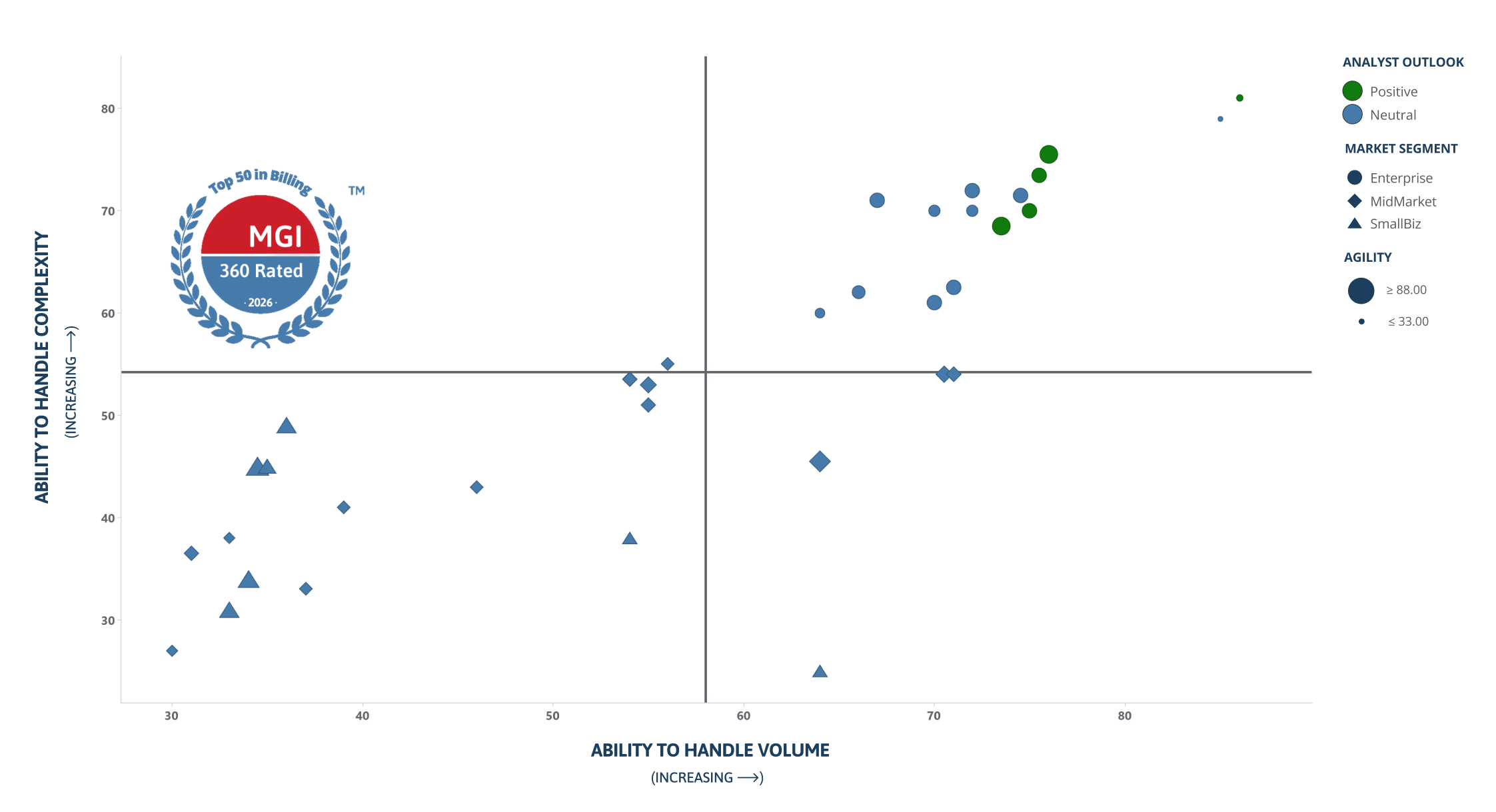
The MGI MarketLens™: Complexity vs. Volume compares MGI 360 Rated™ Agile Billing solutions across these two dimensions. Billing Complexity measures the range of sophisticated billing requirements a platform can support, while Billing Volume measures the scale of billing events it is designed to handle.
Together, these measures help buyers understand which billing solutions align with the complexity and billing event volume requirements of their business.
Why Complexity and Volume Matter
Billing platforms serve organizations with very different operating requirements. A smaller business may need relatively straightforward monetization at modest billing volumes, while larger or more complex organizations may require sophisticated pricing, multiple entities and geographies, regulatory support, or far greater transaction scale.
Usage-based and consumption pricing are also increasing the amount of data billing systems must meter, rate, process, and convert into accurate charges.
A platform capable of processing very large transaction volumes may not necessarily support the most complex billing scenarios. Likewise, a functionally sophisticated billing platform must still operate at the scale required by the business.
What Is Billing Complexity?
Billing Complexity represents the range of pricing, packaging, sales, operational, and regulatory requirements that a billing platform can support.
MGI Research considers factors including:
- product and service complexity
- pricing models and metered approaches
- billing and rating attributes
- sales channels
- payment methods
- geographic and currency requirements
- regulatory and compliance requirements
- the rate of change within the business
Complex environments can include usage-based billing, tiered pricing, bundles, multiple entities, physical and digital products, international invoicing, multiple currencies, and regulated markets.
What Is Billing Volume?
Billing Volume measures the scale of billing events a solution can support.
MGI Research groups billing volume into four categories:
- SmallBiz: fewer than 10,000 billing events per day
- MidMarket: 10,000 to 10 million billing events per day
- Enterprise: 10 million to 100 million billing events per day
- HyperScale: 100 million to 1 billion or more billing events per day
Billing events may include usage activity, invoices, account changes, API calls, statements, metered events, and other transactions the billing system must process.
These categories help buyers identify the scale appropriate to their own operating environment rather than treating maximum capacity as the goal for every organization.
What the 2026 MarketLens™ Shows
The 2026 analysis shows meaningful differences in how billing vendors support Complexity and Volume.
SAP, Oracle, and BillingPlatform receive the three highest scores for both Billing Complexity and Billing Volume.
The MarketLens™ also illustrates broader variation across the market. Some suppliers are better aligned with relatively straightforward, lower-volume environments, while others are positioned for more demanding combinations of complexity and scale.
The report highlights differences among both widely adopted and emerging vendors, reinforcing that market visibility alone does not determine fit for a particular billing environment.
| Key Insight: Billing Complexity and Billing Volume are distinct requirements. Buyers should evaluate both independently and identify the combination that best reflects their current and expected operating needs. |
What Should Buyers Evaluate?
Before comparing vendors, organizations should establish two requirements:
How much billing complexity must the solution support? Consider pricing and product structures, usage and consumption models, sales channels, geographies, currencies, tax and regulatory obligations, invoicing, and payment requirements.
What level of billing volume must the solution handle? Estimate the number and type of billing events generated today and how those requirements may evolve as transaction counts, usage models, products, and customer activity grow.
The objective is not necessarily to select the platform with the highest capacity on either dimension, but to identify the solution best aligned with the organization’s specific combination of complexity and volume requirements.
Explore the 2026 Agile Billing MarketLens™ Series
The 2026 Agile Billing research includes four complementary MarketLens™ analyses:
- Go-to-Market Strength vs. Solution Strength
- Agility vs. Complexity
- Volume vs. Agility
- Complexity vs. Volume
Together, they provide different perspectives on vendor and solution fit within the Agile Billing market.
Get the Full Complexity vs. Volume MarketLens™
The full MGI MarketLens™: Complexity vs. Volume includes the complete 2026 vendor positioning chart and supporting analysis.