Agentic AI promises to transform traditional workflow automation. What is the impact of Agentic AI on vendors like ServiceNow and others that have built their business models around selling software tools that automate workflows?
Introduction
One of the first things one learns in the technology business is that there are no sacred cows. Everything is continuously disrupted and companies who ignore disruption, both an opportunity and as a threat, are bound to become hamburger meat.
At MGI Research, we fully expect Gen AI will significantly disrupt all software markets. The field of enterprise workflow automation tools is not immune as it tries to embrace Agentic AI. This disruption will impact both mainstream incumbents like ServiceNow and Pegasystems, as well as vendors who provide workflow capabilities in nearly every software market such as in contract lifecycle management, CRM, billing, procurement, supply chain management, and many others.
How deep will this change cut into the viability of the incumbents and what is the realistic opportunity for the challengers? Over time, how seriously should software vendors consider the threat to their business? Some voices in the software industry tend to get defensive about Gen AI, and they dismiss viability questions as heresy. The incumbents have huge installed bases, growth, profits, cash, expertise, established partner relationships, and faithful institutional followers on Wall Street. Others, including some in the investment community, see the impact of Gen AI translating into a seminal transition, one that will challenge and perhaps render irrelevant many of the established players. Agentic AI makes legacy workflow automation tool suppliers particularly vulnerable in this transition as it forces a redefinition of what workflow automation is. In this Research Note, we first examine the core of this redefinition and compare traditional workflow automation vs. automation based on Agentic AI. The report also explores when to use each approach and which use cases are ideal.
How deep will this change cut into the viability of the incumbents and what is the realistic opportunity for the challengers? Over time, how seriously should software vendors consider the threat to their business? Some voices in the software industry tend to get defensive about Gen AI, and they dismiss viability questions as heresy. The incumbents have huge installed bases, growth, profits, cash, expertise, established partner relationships, and faithful institutional followers on Wall Street. Others, including some in the investment community, see the impact of Gen AI translating into a seminal transition, one that will challenge and perhaps render irrelevant many of the established players. Agentic AI makes legacy workflow automation tool suppliers particularly vulnerable in this transition as it forces a redefinition of what workflow automation is. In this Research Note, we first examine the core of this redefinition and compare traditional workflow automation vs. automation based on Agentic AI. The report also explores when to use each approach and which use cases are ideal.
Agentic AI vs Traditional Workflow Automation at a High Level
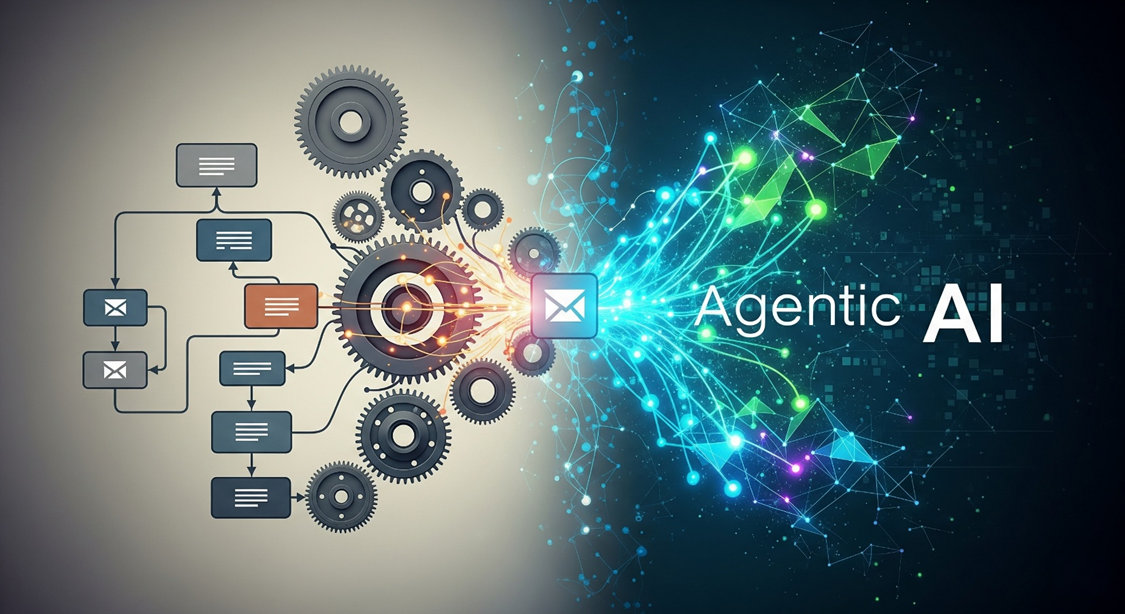
Traditional workflow software like Business Process Management (BPM) suites, IT service management platforms, and Robotic Process Automation (RPA), have long streamlined predictable, routine processes through predefined rules and human-defined flows and escalation rules. These systems excel at enforcing consistency and compliance, but they follow rigid, predetermined paths with limited flexibility. By contrast, Agentic AI (autonomous AI agents) promises a fundamental shift: AI-driven “digital agents” that can make independent decisions, adapt to context, and complete multi-step tasks with minimal human supervision. In essence, if traditional workflows are like a precise assembly line, Agentic AI provides the intelligent manager that can dynamically reconfigure that line in real-time to handle unexpected challenges. To a skeptical industry observer, this sounds too good to be true. Who in their right mind would actually pay for this? It turns out that many companies are willing to try it out because Agentic AI, if proven at scale, promises to deliver capabilities companies simply do not have with traditional workflow automation.
Today’s chatbots and “copilot” assistants only assist users. Tools based on Agentic AI can go further by proactively acting on behalf of users and the actions can be shaped dynamically based on actual context. Today, real deployments of Agentic AI tools lag hype. There are tons of challenges such as governance, security, auditability, compliance, integration, training, and a skillset deficit. There is also the challenge of too much being thrown at users at one time without a chance to consider and assess. We are seeing some indicators of these issues with early adopters of Salesforce Agent Force. Too much innovation too fast can also be a bad thing.
Traditional Workflows vs. Agentic AI: Key Differences and Use Cases
Traditional workflow automation tools (e.g., BPM suites like Pega or Appian, ITSM platforms like ServiceNow, and RPA tools like UiPath) rely on human-designed process maps, business rules, and scripted actions. These systems shine in scenarios with stable, repeatable processes: for example, in a finance approval workflow or an insurance claim process – where each step and decision point can be anticipated and predefined. They of...