Five Ideas to Improve AI Deployments in Finance
As innovation in finance AI has pushed for higher speeds and accuracy, careful governance considerations are being left behind. Differentiation between what can be done and how it should be done is lacking. MGI believes these conversations not only bring safety and security to finance organizations deploying AI, but improved efficacy for AI adoptions as well. Bridging this gap between possible and responsible will reduce risk, improve trust, and lead to more robust deployments of AI in finance. Ignoring the risks of incomplete governance only make consequences more damaging.
The MGI AI Autonomy (AIA) Framework series outlines questions, considerations, and sample methodologies for smarter deployments of AI in finance.
“Re-thinking AI Deployments in Finance” is the second note in this series.
Missed Part 1? Read “Unsafe at Any Speed? A Safety Guide for AI-Based Finance“
Contact us at [email protected] with questions specific to your use case.
This research note breaks down five key governance ideas for finance teams to inject into their AI strategy. Without these considerations, AI deployments in finance are significantly more likely to fail.
01 Break the workflow into small, discrete steps before assigning a governance level.
Treating an AI feature as a single unit when deciding how much autonomy to give is the most common governance error. For example, take billing reconciliation: matching invoices against standard contracts might safely run with full automation. But applying corrections to customer accounts should require a human to approve before anything executes. Treating the full pipeline as one thing produces decisions simultaneously too cautious in some steps and too permissive in others. Breaking the workflow apart is the first move.
02 AI confidence scores require a grading key that doesn’t always exist.
A confidence score only means something if results can be verified against correct answers already known. For some tasks (e.g., determining the start date of a contract), there is one correct answer. For others, such as whether two deliverables in a software contract represent separate revenue obligations under accounting standards, even experienced professionals reviewing the same contract can reach different, equally defensible conclusions. When there is no single correct answer to check against, a high confidence score reflects the model being sure of itself. Not the quality of the answer. Improving AI will not solve this problem.
03 The risk formula has three variables, not one.
Most systems assess AI risk as error rate per transaction. The actual exposure multiplies three variables: 1) how many records the function touches per unit of time (the so-called “blast radius”); 2) how long before a systematic error is detected; and 3) the error rate itself. A 1% error rate on a function processing 10,000 transactions a day with a 90-day detection lag produces 9,000 potentially affected records before anyone notices. The same 1% rate caught in real time produces 100 affected records. Same error rate, but categorically different exposure. The risk formula determines which functions deserve the most governance attention.
04 Some functions should never be automated, period.
Not pending model improvement. Not until the next release. Permanently. Functions requiring personal legal attestation, functions operating under standards where professionals legitimately reach different conclusions, and functions where AI involvement creates risks to finance/company/market integrity belong in a permanent ‘human only’ category regardless of how capable AI becomes. The constraint lives in the obligation or the standard, not in the model. Road-mapping autonomous AI operations for these functions is itself a governance error.
05 AI in reported financials is a market integrity issue, not just an operational one.
When AI-generated positions flow into earnings reports without adequate human oversight, harm extends beyond the company and reaches investors, analysts, and market participants who rely on financial statements as a public good. This is a categorically different risk from a billing error. It cannot be contained within any single company’s accountability framework. This is why it requires a distinct governance response, separate from the measures appropriate for ordinary operational AI risk.
AI Autonomy (AIA) Framework for Governance
Underlying all these considerations is a more prosaic and decisive constraint: data governance. The effectiveness and safety of AI systems are directly tied to the quality, integrity, and control of underlying financial data. AI can be a giant and super-fast error amplifier that presents the data with supreme confidence. Weakness in data lineage, access controls, or consistency can propagate rapidly through AI-driven workflows, undermining both accuracy and auditability. Many organizations are finding data infrastructure – not AI model sophistication – is the primary bottleneck to scaled adoption, especially in organizations experimenting with usage-based pricing models.
Safely adopting AI in finance coalesces around a four-point operating model: 1) clear guidelines on what can and cannot be done with AI in finance, 2) governed autonomy, 3) transparency, and 4) human accountability. Organizations successful at articulating a simple set of rules for AI in finance will dramatically lower the risk of errors going undiscovered and unaccounted for. Financial applications have near-zero tolerance for such mistakes.
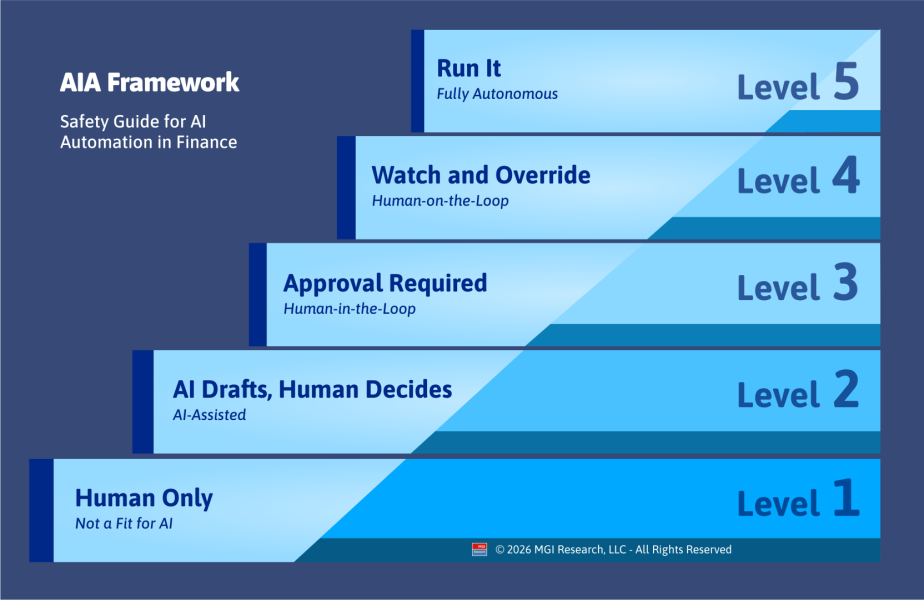
MGI Research created the AI Autonomy (AIA)framework to help finance teams apply the right level of human involvement in Finance AI. This framework consists of five distinct stages outlining how self-driven (autonomous) a specific finance process and capability can be. Determining the appropriate level of autonomy requires finance leaders to ask key questions of each process seeking automation
The Five Levels of AI Autonomy – The AIA Framework
Level 1 – Not a Fit for AI: AI involvement adds risk without meaningful benefit. Tasks automatically become Level 1 if fiduciary/legal responsibility is involved, if human interaction is part of the value exchange, or if AI outputs flow into financial reports impacting investors and market participants. Any one is sufficient to categorize the function as human only.
Level 2 – AI-assisted: AI informs, drafts, or surfaces insight. The human does the work. Appropriate when there is no objective grading standard.
Level 3 – Human-in-the-Loop: AI recommends, a human approves before execution. Required when financial exposure is material or regulatory obligations apply.
Level 4 – Human-on-the-Loop: AI acts, a human can override before consequences become irreversible. Override window must be shorter than reversal window.
Level 5 – Fully Autonomous: AI acts without human review. Errors can be undone cheaply, accuracy is validated, failure spread is controlled.
This report is Part 2 of a series on governance for autonomous AI in finance. Future research will cover topics including:
- Applied Examples of the AIA Framework
- A Message for Investors: Why the Replacement Theory is Incomplete
- The Costs of Common Mistakes in Autonomous AI Deployments
- Pre-Launch Checks and How to Keep Autonomy Checks Current
Part 1 of this series can be accessed here.
Set up an intro call with our analysts with any questions – [email protected].