Contract management is transforming, and the cost of a wrong choice is high
Every promise an organization makes or receives is recorded in a contract. Choosing the Contract Lifecycle Management (CLM) system that manages those commitments is hard to get right the first time. Nearly 40% of first-time buyers replace their first selection within 36 months. This 2026 Buyer’s Guide is an independent assessment of the CLM market, written to shorten evaluations and reduce that cost.
The next 24 to 36 months will redefine the space
The CLM market itself is healthy. MGI estimates the CLM market is growing at roughly 15–20% a year, two to three times the rate of enterprise software overall. It is in better financial health than at any point in its history and offers more choice than ever. Yet the strain of transition is visible: median supplier growth has slowed from 30% to 16%. Five of the 18 suppliers rated in the Buyer’s Guide changed ownership since mid-2024, most of them into private-equity hands. Further change is likely as investors seek to realize gains. MGI expects consolidation in the coming year, and the core definition of CLM to be redefined continuously over the next 24 to 36 months.
A platform chosen or renewed today will live through that change, and CLM decisions tend to stay in place for years. Ownership change can raise a supplier’s investment in its product or cut it, so buyers should know which way their supplier is heading and write price protection, roadmap commitments, and data portability into the contract.
In MGI’s field research, getting it wrong looks like this:
- AI built on poor contract data. An agent acting on flawed contract data repeats the error at a scale no human team could match. Done incorrectly, AI adoption in contract management can do irreparable harm.
- A simple question becomes a project. An executive asks which contracts are exposed to a tariff change or a supplier failure, and the answer takes a team of people and several weeks of manual review.
- The first system gets replaced. A platform bought to fix one department’s problem becomes a replacement project within 24 to 36 months, often repeating the first failure’s mistakes.
The value of contract management is shifting to after signature
For most of its history, CLM was bought and sold as a productivity tool for the legal department, and cycle time was the measure of success. That view is giving way. Processing contracts faster is now the price of admission rather than the prize, and repository, workflow, authoring, and e-signature have become table stakes. Demand is shifting to what happens after signature, where contract value is realized: leakage recovered, renewals captured, obligations enforced, and contract data put to work in sales, procurement, finance, and services.
The shift is far from complete. In most enterprises, contracts still sit in legacy systems, shared folders, and email, out of reach of the people who act on them every day. Revenue leakage alone runs to at least 3 percent of contracted revenue, and as much again on contracted spend, in organizations that cannot see and enforce their own terms. In one example from the full Buyer’s Guide, an analysis of just three large customer agreements at a medical products distributor uncovered an estimated $8 million to $12 million in misapplied pricing and rebate terms.
Key issues the CLM Top 35 Buyer’s Guide answers
- Where does contract management actually pay back: before signature, or after?
- What should buyers watch in a CLM supplier over the next 24 to 36 months?
- Should you replace your CLM with AI, add AI to it, or build your own?
- Is implementation your biggest CLM risk?
- Are AI agents ready to do real contract work?
- Where will value be created as legal AI tools and established CLM platforms converge?
Three findings that will shape your next CLM decision
Long implementations are still a buyer’s risk. Buyers remain cautious about long, high-risk CLM implementation cycles. In MGI’s research, supplier claims that the 18-month implementation is gone coexist with three-year rollouts that are still not live. The executive summary explains how AI is beginning to compress implementations; the full Buyer’s Guide shows how to test time-to-value claims before signing.
Legal AI is winning small and midsize buyers in days, not months. Legal AI tools and lightweight CLM products are winning legal-led buyers in small and midsize organizations, with adoption measured in days rather than months, and they have drawn a large share of investor capital. They remain thin at enterprise scale. The executive summary explains where that disruption is landing, and where it stops.
Investor outcomes will diverge. Heavily funded entrants must now grow into their valuations, deliver on their roadmaps, and prove they can expand beyond legal. Meanwhile, a meaningful number of profitable CLM suppliers lack the growth required to attract a strategic buyer. The executive summary sets out the forces MGI expects to reshape the market in the coming year, and what they mean for investors.
CLM vendors under coverage
This report covers the 35 most consequential vendors in the Contract Lifecycle Management (CLM) market.
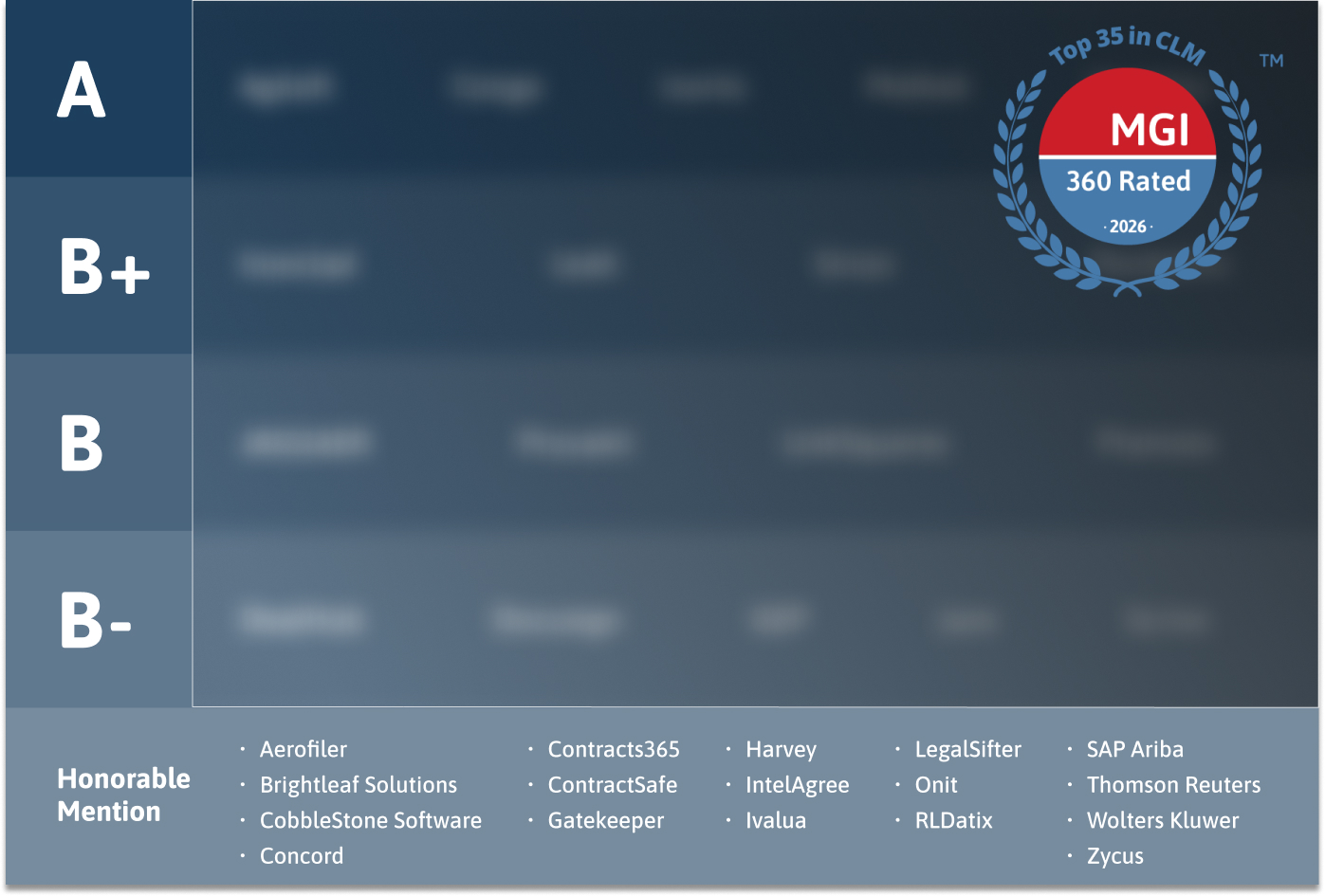
18 vendors receiving full 360 Ratings™, letter grades, and Analyst Outlooks are: Agiloft, Conga, DealHub, Docusign, GEP, Icertis, Ironclad, JAGGAER, Juro, Leah, LinkSquares, Malbek, PandaDoc, Pramata, Provakil, Scrive, Sirion, and Workday.
Click here to view individual MGI 360 Ratings™ for these eighteen companies through MGI Research’s interactive ratings interface.
17 additional noteworthy suppliers that do not yet merit a full 360 Rating™ and are included as Honorable Mentions. These vendors span a wide range of company sizes, vertical focuses, and CLM strategies from legal-centric assistants to enterprise-grade contracting systems for procurement: Aerofiler, Brightleaf Solutions, CobbleStone Software, Concord, ContractSafe, Contracts365, Gatekeeper, Harvey, IntelAgree, Ivalua, LegalSifter, Onit, RLDatix, SAP Ariba, Thomson Reuters, Wolters Kluwer, and Zycus.
Vendors are selected for coverage based on market relevance, solution impact, customer demand, innovation, and alignment with evolving buyer use cases. Inclusion is not based on size, funding, or participation with MGI Research.
What’s inside
The executive summary (publicly available)
- MGI’s market findings and analysis: where demand and value are moving, how AI is reshaping the market, and how supplier ownership and finances are changing
- MGI 360 Ratings™ takeaways
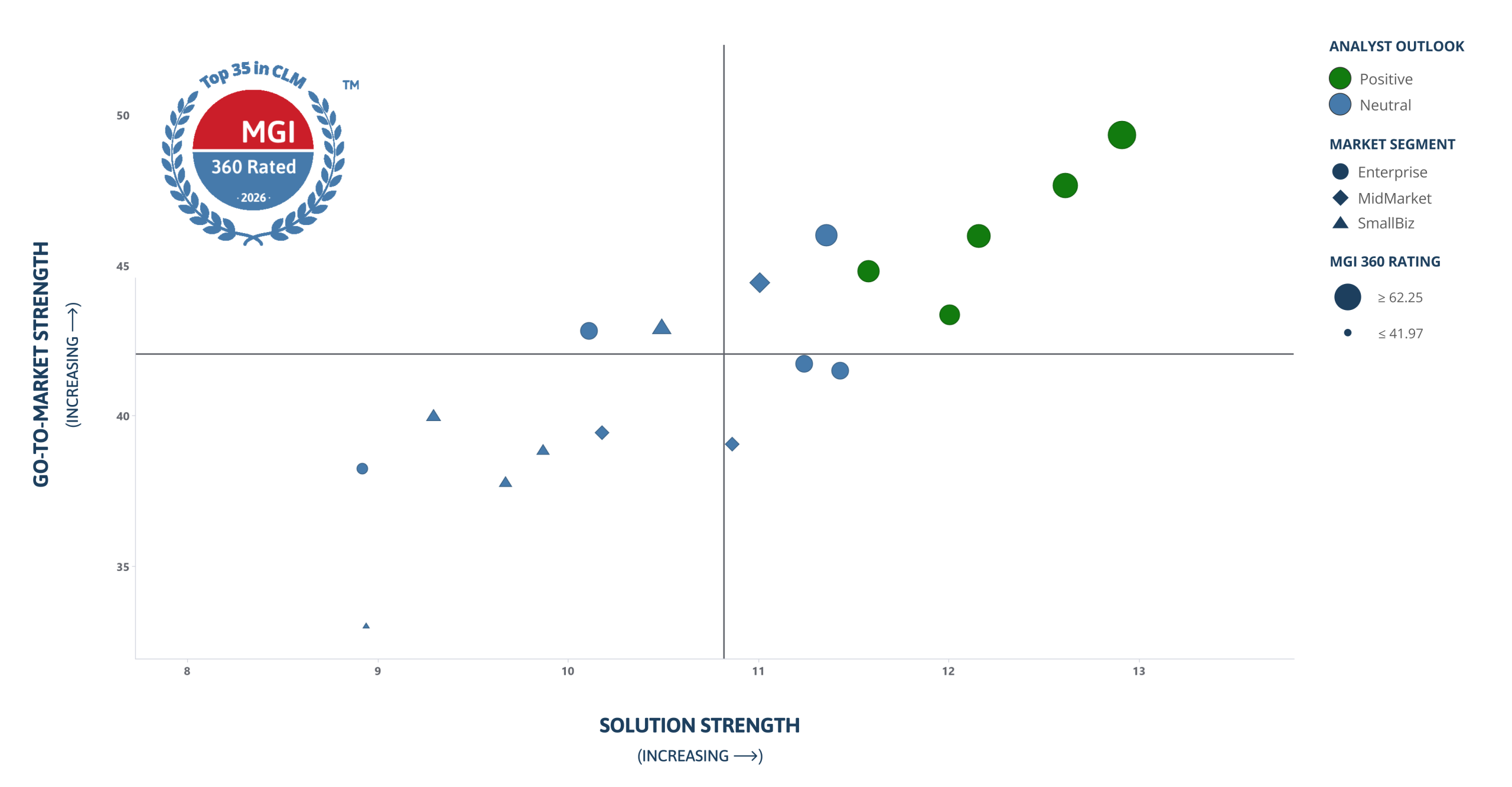
- A preview of where vendors rank and MGI MarketLens™ charts; complete Ratings and MarketLenses are in the full Buyer’s Guide available to clients.
The full Buyer’s Guide (MGI Research clients only)
- Complete MGI 360 Ratings™, letter grades, and Analyst Outlooks for 18 suppliers, plus 17 Honorable Mentions
- Four MGI MarketLens™ charts
- Each rated supplier’s ideal customer profile, sample customers, and direct competitors
- Evaluation and budget guidance
MGI 360 Ratings™ Methodology
MGI 360 Ratings™ are the toughest rating scale in the contract management software market, and they hold every supplier to the same standard: public or private, large or small. Each rated supplier is scored from 1 to 100 across five equally weighted categories, each worth up to 20 points:
- Product: breadth and depth, implementation, and support
- Management: management team, board of directors, and overall company talent
- Strategy: strategy and marketing
- Channel: sales and distribution channels
- Finance: financial health
Together, these categories cover more than 149 data points. Suppliers receive a letter grade (A, B+, B, or B−) based on their quartile. They also receive a qualitative Analyst Outlook: positive, neutral, or negative.
Ratings are built on MGI’s own research, structured interviews with supplier management, board members, and investors, plus interviews with independently sourced customers and partners. Every rating goes through critical internal peer review. MGI 360 Ratings™ are not an endorsement, a predictor of solvency or stock performance, or a recommendation to buy any security.
For the people who buy, fund, and build contract management
- General counsel and legal operations leaders choosing a CLM or deciding whether legal AI tools can stand in for it.
- CFOs, procurement, and revenue operations leaders, who own the leakage, the renewals, and increasingly the CLM budget.
- CIOs and IT leaders deciding which system holds the authoritative contract record as AI agents arrive.
- Private equity and venture investors tracking ownership change, consolidation, and which suppliers can grow into their valuations.
- CLM suppliers, legal AI providers, and systems integrators who need to know how buyers and investors now judge them.
Need help evaluating CLM vendors?
Organizations looking for support in crafting an evaluation strategy for potential CLM suppliers can engage directly with MGI Research analysts. Contact our advisory team for a consultation.