Welcome to The Margin, a newsletter designed to keep you on the leading edge of monetization.
Did you know Google delayed its IPO for a year – because of its confidence in its TAM? Read below for more. Speaking of TAM, next week MGI will present its view of how AI may or may not impact software spending and user budgets in 2026. Many clients have been asking about where and how they can apply AI to their billing systems, and if it’s too early to start thinking about replacing their (expensive and slow-moving) billing system with a modern, AI-based billing engine. Read on for our analysis. We also just launched The Margin Podcast. Find it anywhere you listen to pods and hear conversations with monetization luminaries.
Research Spotlight

Google – Confidence in Its TAM Was a Strategic Weapon
Sizing up a Total Addressable Market (TAM) is not just an exercise to satisfy curiosity or make investors feel good about a company. TAM intelligence can fundamentally alter company strategy, trajectory, and long-term valuation outcomes. One of the best examples of how TAM analysis impacted strategy is Google.
When Google was founded in 1998, search was viewed as a terrible business. Search was considered a backwater industry in Silicon Valley, where search companies were eking out a living as vendors to then-dominant portals like AOL and Yahoo. The business model was banner ads – low price and crudely targeted. Investors questioned why anyone would anyone take it seriously.
Google had the best TAM data among its peers. It knew something its competitors didn’t. Namely, the TAM of its market was far larger than anyone outside the company could imagine. Instead of rushing to IPO, and having to publish its market size estimates, Google took an extra year as a private company. It used the time to grow its sales and marketing teams, improve internal systems, and capture more market share before going public. Google management was confident in search’s market potential and didn’t want to disclose to its competitors just how big the market opportunity was.
The Scale of Google’s Growth
- 1999 Funding: Google raised $25 million at a $100 million valuation, which was genuinely wild for the time and comparable to a Series A reflecting a multi-billion-dollar valuation in today’s terms.
- Today: Google generates more profit than any other U.S. company – more than Apple, Microsoft, or Berkshire Hathaway. Search advertising alone generates over $100 billion annually for Google.
- Market Creation: Google essentially created the modern digital advertising market. They transformed advertising from a cost center based on impressions to a performance-based system where advertisers only pay for clicks and can measure ROI precisely.
Knowing Its TAM Gave Google Confidence to Win
What made Google’s TAM expansion particularly brilliant was that competitors didn’t see it coming. The competition didn’t realize just how large the TAM was. Meanwhile, Google recognized the opportunity and took the time to build its business as a private company. By the time competitors realized that search was the key to the entire digital economy, Google had already built a powerful position in the market, and combined with network effects, Google had established a virtually unassailable position.
Google today demonstrates the ultimate TAM expansion: they didn’t just grow a market – they positioned themselves as the tollbooth for the entire digital economy. Every online transaction, every digital advertisement, every piece of information sought online potentially flows through Google, making their true TAM not just the advertising market, but a percentage of all global commerce that touches the internet.
But it all started by having a clear understanding of the size of its opportunity, gaining the support of its board, taking its time before going public, and capturing market share before the competition. Strong TAM analysis fundamentally altered Google’s market position and ultimate valuation.
Webinar

Does AI Enlarge or Shrink Your TAM? |
|
|
Executives are building the business plans and budgets for 2026 and beyond. A major question every company faces: How will AI impact Total Addressable Market (TAM) and Service Addressable Market (SAM)? On September 25, 2025 at 8AM PDT / 11AM EDT, MGI Research analysts will break down where AI is accelerating user spending, making no difference, or likely to shrink user budgets. Gain insight into:
If you’re responsible for strategy, product, growth, or investor relations, you can’t miss this. |
|
|
Research Spotlight

Will AI Replace Billing Systems? |
|
|
With AI advancing rapidly, many leaders are asking: could AI-native platforms replace billing systems altogether? This new Research Note examines where AI is making a difference in billing today and what to realistically expect in the next five to seven years. While Generative and Agentic AI isn’t yet perfectly suited for the precision demands of core billing logic, it is already reshaping critical adjacent areas like customer support, revenue accounting, fraud detection, contract management, integrations, and implementation projects. For SMEs, AI-first billing may soon be a viable path. For large enterprises, expect incremental AI-driven enhancements from established vendors. Key questions explored:
Bottom line: AI adoption in billing systems is accelerating. The full promise of GenAI Billing Systems (GABS) is still years away, but leaders who elect to ignore AI risk falling behind. Read the full report for adoption timelines, vendor strategies, and buyer recommendations. |
|
|
Introducing: The Margin Podcast

|
We’re excited to launch The Margin Podcast, a new podcast from MGI Research that goes beyond the headlines to unpack the most important trends in AI, monetization, finance, CLM, CPQ, and enterprise software. Hosted by Managing Directors Andrew Dailey and Igor Stenmark, the series explores the strategies and stories shaping the future of digital business. Episode 1: Jane Koltsova on Turning Finance into a Strategic Growth Engine In the debut episode, Andrew Dailey sits down with Jane Koltsova, Sr. Director of Finance Operations and Order to Cash Transformation at Medidata Solutions. Drawing on her experience at Salesforce and PagerDuty, Jane highlights how finance leaders can transform order-to-cash from a back-office necessity into a true driver of growth. She shares insights on revenue recognition, scaling through acquisitions, system upgrades, and building cross-functional alignment across finance, sales, product, and IT. Key Takeaways:
Listen to the first episode on all major platforms and on our website: |
|
|
Research Spotlight
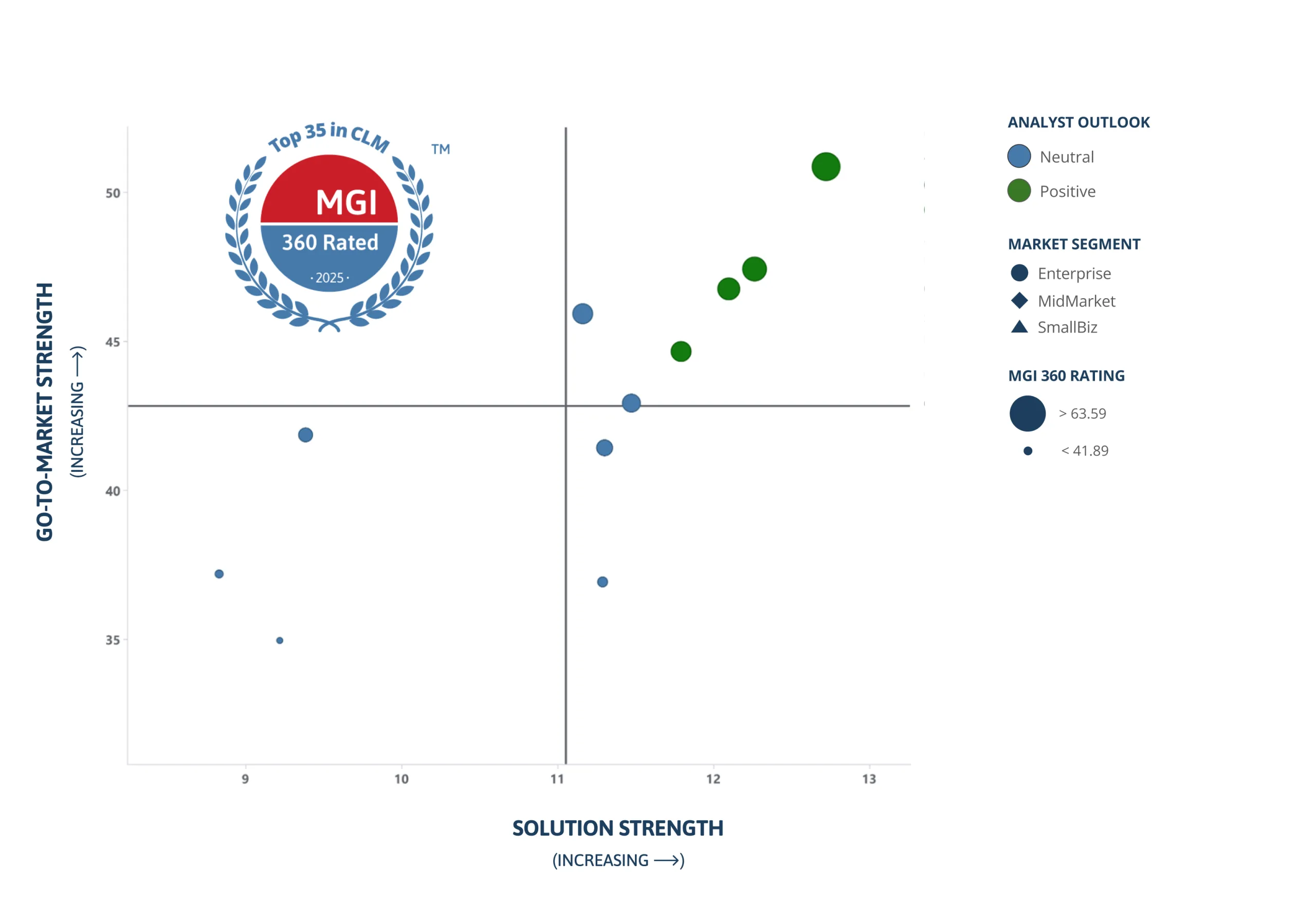
CLM Top 11 Buyer’s Guide for Enterprises – 2025 |
|
|
The new 2025 CLM Buyer’s Guide for Enterprises from MGI Research helps CIOs, legal ops leaders, procurement heads, and investors make informed, risk-aware decisions. It highlights the 11 vendors best equipped to support large, complex organizations and provides independent analysis with MGI 360 Ratings™ and MarketLens™ comparisons.
Vendors covered: Agiloft, Conga, ContractPodAi, GEP, Icertis, JAGGAER, Malbek, Onit, Pramata, Sirion, Workday (Evisort). |
|
|
|
Industry News
|
BillingPlatform Launches ‘Built on BP’ Program BillingPlatform introduced a new partner program, Built on BP, designed to help technology and service partners build and extend solutions on its billing platform. The initiative aims to accelerate innovation and deliver expanded value to customers through a stronger partner ecosystem. Chargebee acquired Inai, a payments orchestration platform, to enhance its AI-powered payments intelligence capabilities. The move highlights the intensity of competition in the low end of the billing and payments market, a segment of the market in which Stripe has been highly disruptive with a strong payments capability and a relatively simple billing solution. Leah (formerly ContractPodAI) Publishes 2025 Statistics & Trends Guide ContractPodAI released Contract Management Statistics & Trends 2025, highlighting insights into how organizations are managing contracts. The guide covers adoption rates, technology trends, and best practices shaping the CLM market. Icertis announced Vera, a new AI-powered contract intelligence solution. Vera introduces smart agents that automate contract drafting, negotiation, and compliance. Kantata Converge 2025 Conference Kantata announced Converge 2025, a free global virtual event taking place September 30–October 2. The conference will gather professional services leaders and analysts to explore industry trends, AI’s impact on services operations, and strategies for growth. Ironclad Study on AI in Procurement Ironclad published a study based on a survey of 800 procurement professionals, finding that while adoption rates vary by sector, AI is viewed as an enabler to improve efficiency, compliance, and strategic decision-making in procurement. Thomson Reuters–Icertis–Accenture Strategic Partnership Thomson Reuters, Icertis, and Accenture announced a three-way partnership to deliver AI-powered contract intelligence. The collaboration integrates Thomson Reuters’ legal AI (CoCounsel) with Icertis’ contract platform and Accenture’s implementation expertise, aiming to transform contract-driven business operations. |
So What Have I Missed?
|
|
|
That’s it for this issue of The Margin. If you’ve made it this far, we’ll certainly see you next time.
Warm wishes,
MGI Research