Welcome to this special M&A edition of The Margin. There have been ten key M&A and financing deals in the billing and monetization space in recent weeks. Salesforce is particularly active — the company is on a deal a month pace. Adyen responded to Stripe’s acquisition of Metronome with its own purchase (of sorts) of Orb. Given the activity we see at MGI, there is likely more M&A and financing to come in the months ahead.
Salesforce Acquires m3ter for Usage-Based Models

Salesforce made three acquisitions in the last 30 days, each filling a distinct layer in a pattern of deliberate platform assembly. m3ter is a metering and rating tool aimed at helping companies monetize their usage-based pricing models. The m3ter acquisition serves a few strategic purposes for Salesforce.
First, it plugs some holes in Salesforce Revenue Cloud Billing capabilities, allowing Salesforce to better compete for prospects with usage billing requirements broadly. Second, it allows Salesforce Revenue Cloud to be a contender in deals with AI-native prospects. Salesforce now has an answer to Stripe’s acquisition of Metronome (see MGI analysis), which has been winning deals in this segment. Third, Salesforce will extensively use m3ter internally. MGI estimates the value of internal m3ter usage within Salesforce could exceed $100 million per year.
This acquisition was a follow-on to an earlier partnership and modest investment in London-based m3ter. Prior to the deal, m3ter raised a total of $31.5 million in venture funding. While pricing was not announced, MGI estimates the likely consideration was in the range of $150 million with trailing m3ter revenues of just under $10 million.
Recent Salesforce Acquisitions
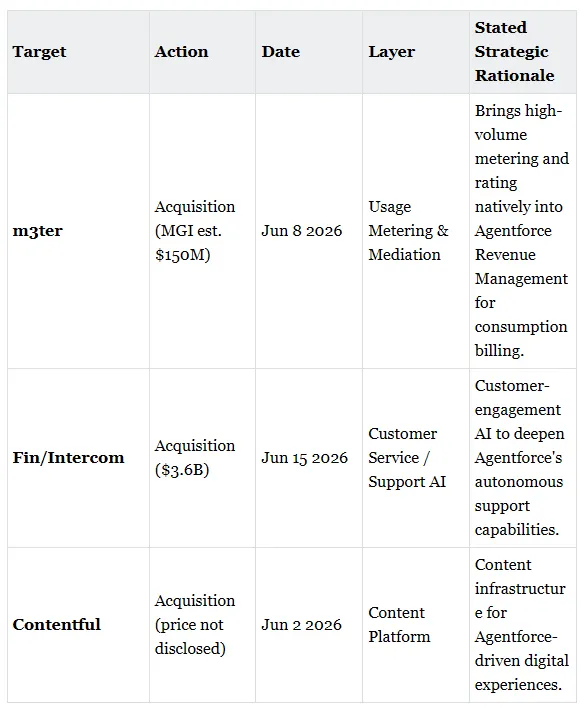
Earlier, Salesforce completed the acquisition of Informatica, positioning it as the data integration and master data management layer for Agentforce.
Adyen Acquires Orb for $335M

On June 11, a few days after the m3ter transaction announcement, Adyen disclosed its purchase of Orb. Orb is a San Francisco usage-based billing platform tracking real-time usage events and translating complex pricing contracts into invoices. Founded 2021, Orb raised $44M from Mayfield, Menlo Ventures, and Greylock Partners. Clients include Vercel, Replit, Glean, and Supabase, AI-native, consumption-heavy businesses where the AI monetization problem is most acute.
It is widely perceived Adyen paid $335M in an all-cash deal for a five-year-old company. MGI believes the Orb-Adyen deal structure is much more complex and actual amounts going to Orb are more modest. Adyen is setting up an incubator with a funding commitment of $335 million. It is likely some portion of the $335 million will go to Orb investors and founders, and some cash may be immediately converted into Adyen stock. MGI estimates prior to the acquisition Orb was a sub-$10 million revenue business.
The strategic logic is Adyen wants to capture payment volumes from the new generation of usage-centric merchants as well as leverage the product for internal use, while also creating a closed loop infrastructure for billing and payments. This is Adyen’s second major acquisition in two months alongside Talon.One (loyalty/incentives, €750M) in April. Both transactions are expected to close on July 1, 2026. As with Salesforce/m3ter deal, Adyen ultimately chose to spend more than a third of a billion dollars to buy metering and billing rather than develop internally, in spite of high cost of capital and economic uncertainty.
Other Recent M&A and Investment Transactions
Transaction: Ramp – Investment, $750M @ $44B Valuation
- Target: Ramp is a spend-management platform that started as a corporate card, and is now running the full money-out side of the CFO office (cards, expenses, AP/bill pay, procurement, travel) with AI auto-coding transactions, matching receipts, and enforcing policy in real time. Ramp monetizes on interchange, so the software is free and the card is the meter. It sits at the control layer of corporate spend, between the ERP and every employee who spends a dollar.
- Investors: ICONIQ, GIC, Ontario Teachers
- Why: This is a bet AI-token spend becomes the third pillar of corporate cost after people and vendors, and whoever owns the spend-control surface owns this new line item.
Transaction: Chronograph – Investment, $140M
- Target: Portfolio-monitoring and reporting infrastructure for private capital – GPs and LPs. Turns disjointed private-market data (scattered PDFs, Excel, capital accounts, valuation marks across buyout, credit, infra, secondaries) into a single auditable source of truth, with click-through lineage from any number back to its source document, plus simplified LP reporting. Backed by Summit, Carlyle, and Nasdaq.
- Investor: Sixth Street Growth
- Why: “Portfolio monitoring” sounds like a weekend vibe-code despite the $140M check. The value isn’t the dashboard, it’s auditability – provable, traceable numbers across thousands of illiquid positions with no public price and an LP audit on the line.
Transaction: Leapfin – Acquisition, undisclosed (Jun 4)
- Target: Revenue recognition and reconciliation engine. Standardizes messy, high-volume transactional data into ASC 606 / IFRS 15-compliant, GAAP-ready financials and automates the record-to-report close. Sits at the back of the stack, between raw transactions and the closed books – increasingly via “accounting AI agents.”
- Buyer: Airwallex – Melbourne-founded global payments platform ($266B annual volume, 250,000+ customers). A processor extending into the back office.
- Why: Airwallex bought rev rec to close the loop from payment acceptance to book close. Rev rec has historically lagged the rest of the stack in automation precisely because it’s standards-governed and difficult.
Transaction: Vendr – Acquisition, undisclosed (Jun 1)
- Target: SaaS-purchasing platform sitting on years of real software-pricing data – what companies actually pay – used to benchmark and negotiate renewals. The spend-intelligence layer of the CFO office.
- Buyer: Vertice – AI procurement platform. Folding Vendr in to build a large procurement-intelligence dataset and power autonomous AI negotiation.
- Why: Procurement intelligence is consolidating and the prize is the dataset, not the workflow. The theory is pricing data is the moat; whoever has the most data trains the best negotiation agent.
Transaction: Billables AI – Investment, $10.2M Series A (Jun 9)
- Target: Legal timekeeping and operational-intelligence platform. Integrates with Microsoft 365, Google Workspace, Zoom, Adobe, and practice-management tools (Clio, MyCase, LeanLaw, Litify) via API to passively capture attorney work and auto-generate billing narratives, then layers on productivity insights, revenue forecasting, and AI-usage tracking for governance.
- Investors: Avenue Growth Partners (lead), Wing VC, SignalFire, Alumni Ventures.
- Why: It targets unbilled time, the revenue-leakage problem at its source. The API-first approach (vs. screen-monitoring rivals) is the wedge.
Transaction: Finovox – Investment, ~$9M / €8.2M (Jun 8)
- Target: French document-fraud detection platform. AI analyzes invoices, quotes, pay slips, bank statements, and IDs for tampering, and generates a privacy-preserving “digital fingerprint” so a fraudulent document is flagged if it’s reused across the network. Used by PwC France, insurers, and lenders at onboarding, claims, and financing checkpoints. A tailwind from France’s 2026 mandatory e-invoicing rules, it sits as a verification gate in front of AP/AR and underwriting.
- Investors: Investor group, including Blast Club and VAeX Capital Partners.
- Why: Seed/early capital into invoice intelligence says the data-authenticity and fraud problem in AP/AR is still unsolved at scale. Even with mature AP automation everywhere, “is this invoice real and is the data right” remains an open, fundable problem. Regulation (e-invoicing mandates) is forcing the issue.
Agile Billing Buyer's Guide and Market Overview

Upcoming Webinar – Register
July 23, 2026 · 8 AM PT / 11 AM ET / 5 PM CET
MGI analysts share the latest MGI 360 Ratings™ of billing vendors, a tool-kit for users to run an evaluation, and where the market is heading — including how M3 (Multi-modal Monetization) requirements are separating the field.
See how SAP, Zuora, BillingPlatform, Gotransverse, Logisense, Salesforce, Stripe, and others score.
For a confidential discussion of software valuation metrics, drivers and benchmarks or to access our valuation formulas, schedule a confidential call with an MGI analyst team at [email protected].
So What Have I Missed?
Our most recent and relevant research that will help you keep your finger on the pulse of AMP disciplines.
- Webcast: The Future of AI Monetization (M3) (June 11)
- Webcast: Agile Billing Buyer’s Guide and Market Outlook (July 23)
- Interactive Model: MGI Pricing Migration Model — interactive seat-to-M3 revenue transition tool
- Research Note: Unsafe at Any Speed? A Safety Guide for AI-Based Finance
- Webinar: From Seats to Usage: AI Impact Analysis for Software Buyers + Vendors
- MarketLens Report: MGI MarketLens™: Contract Lifecycle Management (CLM)
- MarketLens Report: Agile Billing MarketLens™ series
- MarketLens Report: CPQ MarketLens™ series
The Evergreen Archives
Curated past research that is still pertinent today.
- State of Monetization
- What Every CEO Needs to Know About Subscription Business
- Six Stages of CLM
- Mediation 2.0: Taking on the Data Challenge in Agile Billing
- Quote-to-Cash Is Dead; Long Live Prospect-to-Disclosure
- Headless eCommerce Architecture: Is eCommerce Losing Its Head?
- How to Scale Monetization Globally
- Evolution of MoR into Monetization as a Service
That’s all for this of issue of The Margin. If you’ve made it this far, we’ll certainly see you next time.
Warm Wishes, MGI Research