Welcome back to The Margin, a newsletter designed to keep you on the leading edge of monetization.
Today’s lead story is the rapidly growing pressure on enterprises seeking to monetize AI-enabled products and services. This trend is the focus of continuous client work and recent MGI research notes. In addition, two webinars and podcasts (May and June) deal with the subject. Increasingly, CFOs are being asked (or are asking themselves): “What is our AI margin?” They find usage-based pricing, billing, and the correct rev rec tools are key ingredients of making AI adoption a viable, profitable business. Enterprise monetization stacks across industries are being pressure-tested by these new pricing models, and the results are often alarming. Companies discover their billing and rev rec tools are inadequate, their business lacks necessary skill sets to make the transition, and current best practices are out of line with the new average. Evidence from field research, questions from finance/technology/business clients, and conversations at industry events are data-points supporting these themes.
Why This Is Still Early, and Why the Market Just Proved Our Thesis

Fewer than 5% of organizations have adequate skills and tools for usage-based pricing – the key ingredient for AI monetization. Yet 75%+ of software companies plan to deploy usage billing within twelve months. (MGI Research 2026 survey).
The pattern we see in our work and in market data is consistent: companies tend to go through three stages before recognizing AI monetization is a real challenge. First, they assume usage pricing is a simple change to the price book and anoint a pricing lead to tinker with new SKUs. Then the CFO asks “what is my AI margin?” and there is no answer. Second, they conclude they have a solution because the product/engineering team signed up with Stripe, Salesforce, or another billing vendor that references usage billing in marketing collateral. Normally, what one thinks to be the answer is only 10 percent of a whole solution. Still lacking are needs like the ability to handle billing in volume and providing transparent access to event and billing records. Customers want to see their usage in at least quick-time. Getting to the other 90 percent (e.g., mediation at AI-era event volumes, rating engine flexibility, rev rec compliance [ASC 606/IFRS 15 for variable consideration], CSM tooling for bill-shock prevention, entitlements enforcement) typically remains unaddressed. Everyone focuses on new prices, but pricing may actually be the easy part. Third, organizations discover the monetization capability gap after committing to an AI product launch. This is where the real costs appear. MGI estimates $1M–$5M+ to remediate a broken usage billing stack after go-live problems surface. This cost is rarely in the business case, nor does it account for the damage to customer relationships.
The primitive argument that any monetization challenge can be vibe-coded has now been exposed as amateurish. Coding assistants can turbo charge software productivity, but the “vibe coding” argument – a developer can wire together APIs and deliver a working enterprise-grade usage billing stack in a sprint – runs directly into a wall when AI product volumes scale, customers question invoices, and when the first ASC 606 audit question arrives.
The AI Monetization challenge will be largely resolved through Buy not Build strategies. The M&A market is confirming our thesis in real time. There is a clear pickup in activity with several recent transactions really standing out:
- Salesforce acquiring usage metering and rating software supplier m3ter, and
- Global payment processing firm Adyen acquiring high volume usage billing provider Orb.
These transactions are indicative of where the market is heading. Both acquiring organizations have nearly unlimited resources for building just about anything they want. Each has large, sophisticated software engineering teams. But when it came to critical components of enabling AI monetization, both major software platforms chose to acquire the metering layer rather than build it. Any other software company that believes it can be successful with a Build strategy should carefully re-consider its logic. The market trend towards Buy is growing despite today’s relatively high cost of capital.
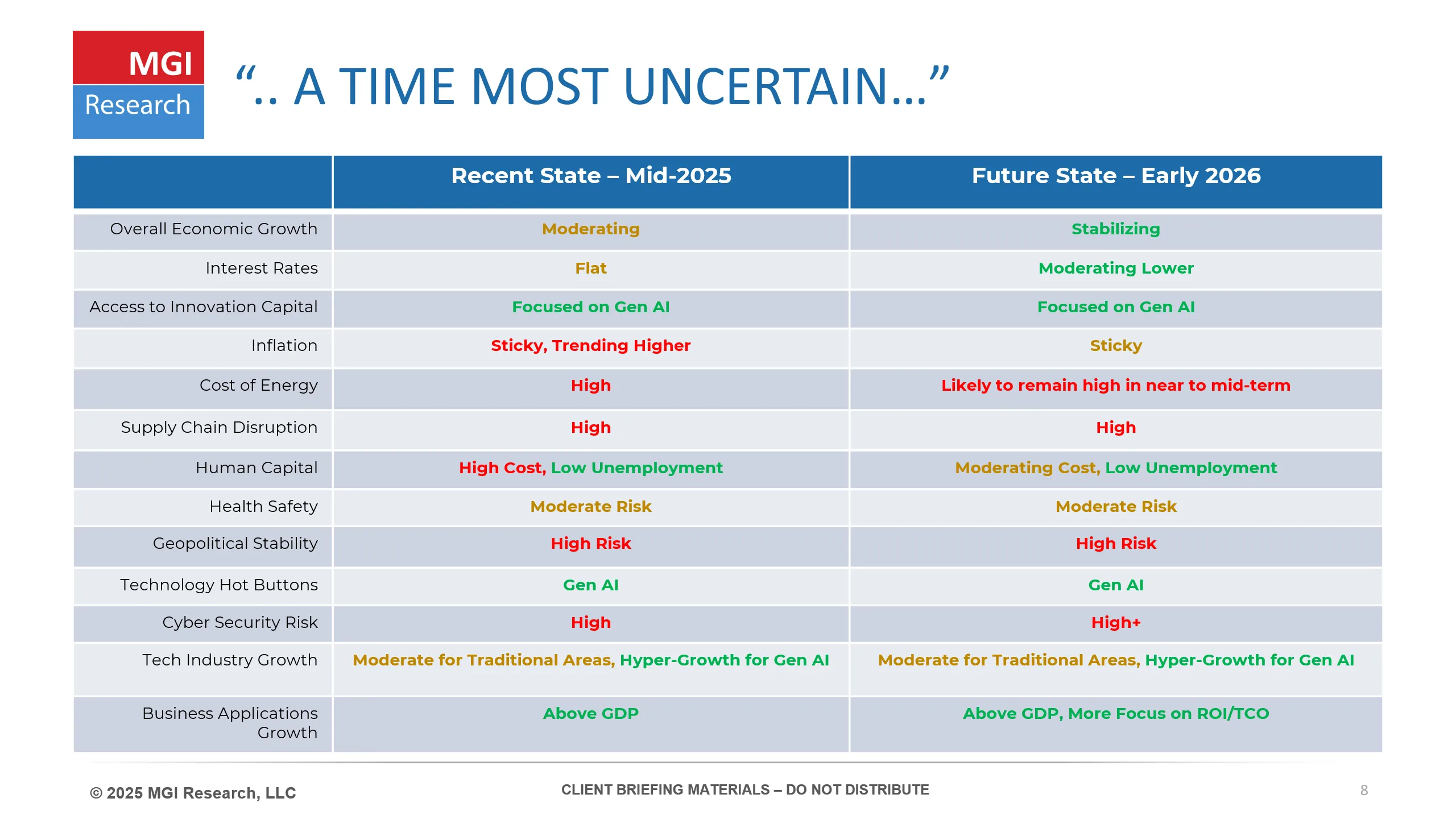
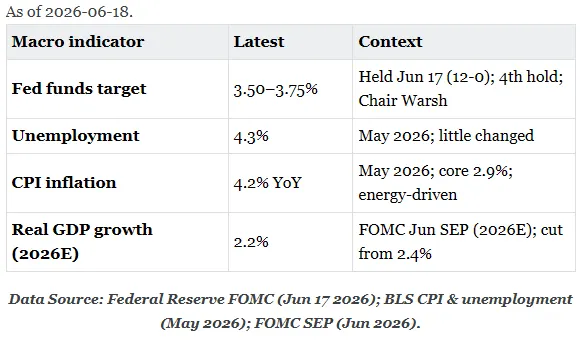
The current global economic landscape continues to be volatile with multiple economic and geopolitical risk cross-currents. In early 2025, MGI Research’s economic scenario predicted a period of “higher for longer” interest rates with persistent, sticky inflation refusing to back down, and lower than expected GDP growth. At the time, this was a set of ideas highly contrary to the then accepted notion the US Fed was about to cut rates significantly and often. The current economic landscape supports our earlier view of modest growth, sticky inflation, and higher rates.
The Margin Economic Dashboard – US Snapshot
Our 2025 scenario pointed out persistently high interest rates would put a short-term damper on M&A deal activity, but markets ultimately would adjust and learn how to live with higher interest rates. This prediction is being realized, specifically in the monetization software arena.
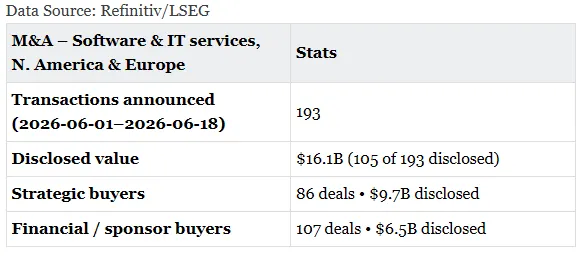
Over the last several weeks, we analyzed 193 recent software and IT-services transactions worth $16.1 billion in disclosed value across North America and Europe. While clearly not a full list, it is enough of a representative sample. There are several important takeaways:
- Software is far from dead and areas strategic for AI adoption are getting the lion share of capital.
- Strategic buyers are back in spades, and showing a willingness to do multiple deals even in the same quarter. Within analyzed M&A activity, strategic buyers concentrated the dollars at $9.7B vs. $6.5B for financial sponsors. Deals of significant value are capability acquisitions. Against a backdrop of a Fed holding at 3.50–3.75% and inflation at 4.2%, incumbents are buying what they cannot build fast enough. This is an important revelation: the build-vs-buy clock on monetization infrastructure has compressed beyond what even the largest platforms can absorb with AI-assisted organic development.
- User organizations are unprepared for the coming software consolidation. The notion that their software supplier may be acquired and create an impact is something that many organizations have already forgotten. Many of the professionals that used to have deep expertise in this area are retired or leaving soon.
The Margin Deal Dashboard (select sample)
We expect the pace of M&A transactions in Monetization to pick up over the next 12-18 months. Software buyers are disoriented, claims of AI vibe coding generate industry noise drowning out (but not altering) reality, vendors and their boards and investors are nervous, uncertainty drives fear and stimulates willingness to look at strategic options.
Where does MGI fit? In today’s uncertain and noisy environment, a close relationship with an independent and knowledgeable advisor can help organizations reduce risks, prevent costly strategic mistakes and optimize costs. Through published research, ratings, data, tools and confidential unbiased advisory engagements, we help our clients create value.
Watch the June 11 MGI webcast replay: https://mgiresearch.com/webinar/future-of-ai-monetization/
Talk to an MGI analyst: https://mgiresearch.com/contact-us/ or email to [email protected]
Agile Billing Buyer’s Guide and Market Overview

Upcoming Webinar – Register
June 23, 2026 | 8AM PT / 11AM ET
MGI analysts reveal the latest MGI 360 Ratings™ of billing vendors, a tool-kit for users to run an evaluation, and where the market is heading – including how M3 (Multi-modal Monetization) requirements are separating the field. See how SAP, Zuora, BillingPlatform, Gotransverse, Logisense, Salesforce, Stripe, and others score.
So What Have I Missed?
Our most recent and relevant research that will help you keep your finger on the pulse of AMP disciplines.
- Webcast: The Future of AI Monetization (M3) (June 11)
- Webcast: Agile Billing Buyer’s Guide and Market Outlook (July 23)
- Interactive Model: MGI Pricing Migration Model – interactive seat-to-M3 revenue transition tool
- Research Note: Unsafe at Any Speed? A Safety Guide for AI-Based Finance
- Webinar: From Seats to Usage: AI Impact Analysis for Software Buyers + Vendors
- MarketLens Report: MGI MarketLens™: Contract Lifecycle Management (CLM)
- MarketLens Report: Agile Billing MarketLens™ series
- MarketLens Report: CPQ MarketLens™ series
The Evergreen Archives
Curated past research that is still pertinent today.
- State of Monetization
- What Every CEO Needs to Know About Subscription Business
- Six Stages of CLM
- Mediation 2.0: Taking on the Data Challenge in Agile Billing
- Quote-to-Cash Is Dead; Long Live Prospect-to-Disclosure
- Headless eCommerce Architecture: Is eCommerce Losing Its Head?
- How to Scale Monetization Globally
- Evolution of MoR into Monetization as a Service