
Welcome to The Margin, a newsletter designed to keep you on the leading edge of monetization.
In business, the difference between being ahead of the curve or slow to adapt is anything but marginal. The Margin aims to be the most useful, timely, and incisive ping that hits your inbox all week. It includes critical research and analyst insights to inform short and long-term decision making.
Rolls-Royce, Henry Ford, and Agentic AI

History offers a useful lens for understanding today’s Agentic AI moment. In the early 20th century, Rolls-Royce and Henry Ford both built successful businesses by pursuing radically different models. Rolls-Royce produced exquisitely crafted, bespoke vehicles for a narrow, high-net-worth audience. Ford, by contrast, standardized parts, processes, and pricing to serve the mass market, driving down costs and enabling a vast ecosystem of suppliers, mechanics, and aftermarket innovation.
Both companies won in their own ways, but Ford’s emphasis on standardization, repeatability, and accessibility unlocked scale, ecosystem growth, and enduring economic impact. The Model T wasn’t perfect and required frequent maintenance, but its simplicity made it extensible, serviceable, and widely adopted.
Agentic AI today looks more like early Rolls-Royce than Ford. Most implementations are highly customized, outcomes vary, and success depends on skilled practitioners stitching together probabilistic systems. While this flexibility is powerful, it also limits scalability. Broad adoption will depend less on raw technical capability and more on standardized agent frameworks, predictable outcomes, stable APIs, lifecycle management tooling, and pricing models that are easy to understand and budget for.
As Agentic AI matures, the winners are unlikely to be those with the most advanced models or the earliest announcements. Instead, history suggests advantage will accrue to companies that prioritize simplicity over elegance, repeatability over customization, and ecosystems over one-off wins. Standardized processes, consistent business outcomes, and clear pricing will ultimately determine who scales and who remains bespoke.
Read Research Note: https://mgiresearch.com/research/rolls-royce-henry-ford-and-agentic-ai
Upcoming Webinar
CPQ Buyer’s Guide Update
February 12, 2026 | 8AM PST / 11AM EST

CPQ is a crucial tool for creating a smooth, agile, and successful monetization process. Pricing, packaging, bundling, and quoting are all processes that require precision and speed to shorten sales cycles, reduce discounting, maximize size of sales transactions, and create positive customer relationships. The CPQ market today is highly fragmented, characterized by distinct pools of suppliers that compete within narrow niches. Many of the vendors in this space will see a few competitors across all deals, often never seeing anyone outside of their pocket. MGI Research will share what these niches are, who plays where, and what to look for in various ideal use cases. Join MGI analysts as we share our updated CPQ MarketLenses™, latest MGI 360 Ratings™, analysis of use cases and stack-ranking of top CPQ vendors. Market trends, scenarios for disruption will all be discussed, followed by live Q&A.
Vendors rated and/or analyzed in the Buyers Guide:
Bit2win, Configit, Conga, DealHub.io, Epicor, ExpediteCommerce, Experlogix, Nue.io, Oracle, PandaDoc, PROS, Revalize, Salesforce, SAP, ServiceNow, servicePath™, Tacton, and Workday.
Reserve Your Seat:
https://us02web.zoom.us/webinar/register/4717647071823/WN_1G4lWZpzRMuZ9tAtzsmZoQ
For a confidential discussion of software valuation metrics, drivers and benchmarks or to access our valuation formulas, schedule a confidential call with an MGI analyst.
Webinar Replay
The AI Bubble — 2026 Software Valuation Update

What is your Software Business Worth?
In this recent MGI Research webinar, Co-Managing Directors Andrew Dailey and Igor Stenmark unpack what’s actually driving software valuations today and why the AI narrative is obscuring important signals.
Beneath the AI headlines, the data identify critical software business valuation drivers. This analysis highlights where markets may be mispricing risk, growth, and opportunity.
A few signals stood out clearly in the data:
- Software valuations are at the low-end of its historical range
- Growth and profitability of software business is higher than in prior benchmarks
- Does being a SaaS company matter anymore?
- Learn about MGI AI Index and how it impacts valuation multiples
- Does the Rule of 40 still apply and does it matter as a valuation driver?
- What current valuation metrics may signal where software M&A is heading in 2026
This session is designed for software CEOs, CFOs, operators, investors, and buyers navigating a rapidly shifting valuation landscape.
Watch Replay: https://mgiresearch.com/webinar/2026-software-valuation-update/
The Margin Podcast, Episode 12
Pricing in Motion: Dr. Michael Wu on AI, Data, and Demand
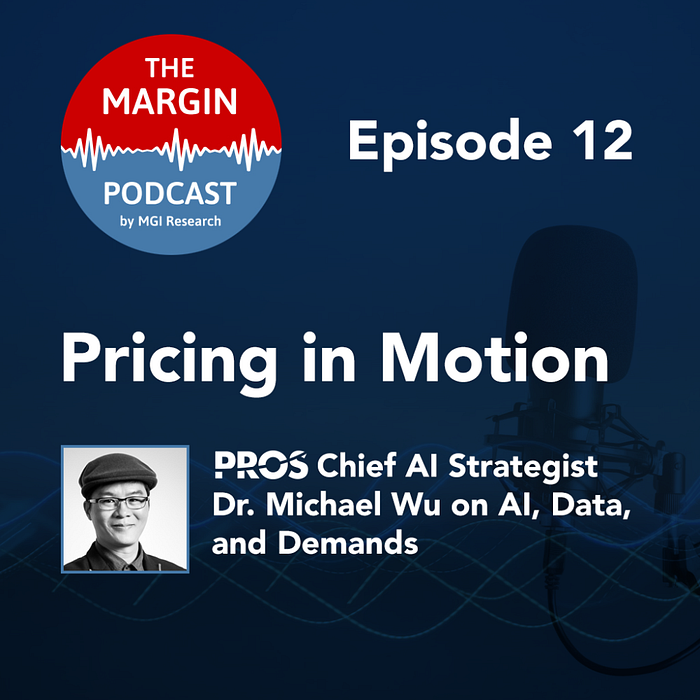
In this episode of The Margin, Andrew Dailey, Managing Director at MGI Research, speaks with Dr. Michael Wu, Chief AI Strategist at PROS, about what other industries can learn from decades of airline experience in dynamic pricing and revenue optimization. Dr. Wu shares insights on building trust in AI, leveraging data to drive price precision, and accelerating quote times in complex B2B environments. They also explore the shift from black-box to glass-box AI, the power of 1% pricing changes, and how CFOs can start preparing now for AI-powered pricing transformation.
What you’ll learn in this episode:
- Why the airline industry became the blueprint for real-time pricing, yield management, and demand sensing
- How AI-powered pricing enables businesses to operate dynamically in volatile markets at scale
- Why data readiness and automation are prerequisites for effective AI-driven pricing decisions
- How trust, visibility into pricing decisions, and change management determine whether AI pricing actually delivers value
- Why pricing is the fastest and most powerful lever CFOs can pull to drive margin, revenue, and competitive advantage
Listen to this Episode: https://mgiresearch.com/podcast/pricing-in-motion-dr-michael-wu-on-ai-data-and-demand/
MGI Funding Notes
Where capital is flowing: control, not acceleration
The recent funding activity in monetization reinforces a pattern we continue to see across finance, revenue, and legal software: capital is concentrating around products that reduce exposure, enforce discipline, and make execution more predictable. Growth narratives are still present, but they are no longer sufficient on their own. Investors — and increasingly buyers — are prioritizing software that holds up under scrutiny.
Below, we look at what the latest rounds tell us, and why they matter now
Antidote — $5M Seed (Billing Risk)
Company summary: Antidote provides software that automates controls and checks across billing and compliance workflows to identify and reduce billing errors.
Billing failures rarely announce themselves. They accumulate quietly through disputes, delayed collections, and customer friction. Antidote’s seed round is notable not for its size, but for the signal it sends: billing risk remains inadequately addressed by core billing platforms, leaving room for dedicated control layers.
Rather than waiting for incumbents to harden their systems, buyers appear increasingly willing to add external safeguards. This reflects a broader acceptance that correctness cannot be assumed — even in systems of record.
Why it matters now: As finance teams face greater audit and customer scrutiny, tolerance for “downstream cleanup” in billing is narrowing.
Concourse — $12M Series A (AI in Finance Execution)
Company summary: Concourse develops AI-driven agents designed to operate within corporate finance workflows such as accounting operations and financial execution.
Concourse is operating in a difficult but revealing part of the market. Unlike many AI vendors focused on analysis or insights, it targets execution — where errors are visible, regulated, and costly. The Series A suggests investors believe AI can move into these workflows without breaking trust.
The open question is buyer readiness. Finance leaders want automation but remain cautious about delegating judgment in environments where explainability and control are non-negotiable.
Why it matters now: AI is being tested in finance where mistakes are least tolerated, setting a higher bar for adoption across the category.
Datarails — $70M Series C (FP&A and Revenue Performance)
Company summary: Datarails offers an FP&A platform that connects financial planning, forecasting, and variance analysis with underlying financial and revenue data.
Datarails’ raise reflects a shift in how FP&A is being used inside organizations. Planning teams are increasingly expected not just to forecast, but to explain performance gaps and surface revenue risk as it emerges.
The funding underscores sustained demand for tools that connect plans to reality. Improving forecast accuracy matters less than understanding why outcomes diverge — and who is accountable when they do.
Why it matters now: FP&A is being pulled closer to revenue ownership, increasing pressure on tools that only model rather than explain.
DealHub — $100M Growth Round (CPQ as Governance)
Company summary: DealHub provides a CPQ platform used by enterprise sales and finance teams to manage pricing, deal configuration, and commercial approvals.
DealHub’s recent funding round reinforces CPQ’s evolving role. As deals become more complex, CPQ is increasingly valued for enforcing pricing discipline and approval logic before revenue is committed, not for speeding deals through.
This reframes CPQ as a control surface rather than a sales tool. In practice, that pulls CPQ closer to finance and raises expectations around auditability and downstream impact.
Why it matters now: Enterprises are using CPQ to prevent revenue problems at the source, not fix them after contracts are signed.
Juspay — $50M Series D Extension at ~$1.2B Valuation (Payments)
Company summary: Juspay builds payments infrastructure used by enterprises to process and manage high-volume digital transactions, particularly in emerging and high-growth markets.
Juspay’s extension round signals durability rather than ambition. In payments, scale and reliability continue to matter more than novelty, especially in markets where legacy infrastructure struggles to keep up.
As enterprises reassess risk across their monetization stacks, payments providers that demonstrate operational consistency remain strategically valuable.
Why it matters now: Payments is being treated less as a growth lever and more as infrastructure that must not fail.
Ivo — $55M Series B (AI and Contract Review)
Company summary: Ivo develops AI-based software focused on accelerating and improving contract review within legal and commercial workflows.
Ivo’s raise reflects growing frustration with CLM platforms that manage documents but do little to influence decisions. Contract review remains a bottleneck that directly affects deal velocity and revenue exposure.
By narrowing its focus to high-friction review workflows, Ivo highlights a broader tension in CLM: buyers are questioning whether breadth delivers more value than precision.
Why it matters now: Contract intelligence is shifting from record-keeping to intervention at decision points that affect revenue.
Midship — $4.15M Seed (SOX and Internal Controls)
Company summary: Midship provides software that automates Sarbanes-Oxley testing and internal audit evidence collection.
SOX compliance remains heavily manual despite decades of tooling. Midship’s seed round points to ongoing dissatisfaction with how controls are tested and documented.
The value proposition here is incremental but meaningful: fewer manual checks, fewer errors, and less disruption during audit cycles.
Why it matters now: Finance teams are under pressure to reduce compliance cost without weakening controls.
SpotDraft — $8M Series B Extension at $380M Valuation (CLM)
Company summary: SpotDraft offers a contract lifecycle management platform serving mid-market and enterprise legal and business teams.
SpotDraft’s extension reflects a more cautious funding environment in CLM. Capital remains available, but valuation expansion now depends less on features and more on enterprise scale and operational depth.
This signals a category moving from expansion to consolidation, with fewer rewards for incremental differentiation.
Why it matters now: CLM vendors are being judged on durability and footprint, not feature velocity.
Summize — $50M PE Round (Legal Ops Consolidation)
Company summary: Summize provides contract management software and services focused on in-house legal teams, with a strong footprint in European markets. Summize raised $50 million from a group of private equity investors to scale its in-house contract management platform. The raise signals PE interest in consolidating fragmented legal operations markets, particularly in Europe. As CLM matures, investor focus is shifting from growth narratives to operational leverage and roll-up potential.
Why it matters now: CLM is transitioning from rapid growth category to consolidation target.
Upcoming Events
Meet MGI at these upcoming events:
- March 2–5, 2026
- Barcelona
- March 9–11, 2026
- Orlando, FL
- April 15–16, 2026
- San Francisco, CA
- April 20–24, 2026
- Hannover, DE
World Commerce and Contracting EMEA Summit 2026
- April 20–21, 2026
- Berlin, DE
- April 22–24, 2026
- Las Vegas, NV
- April 28–30, 2026
- San Francisco, CA
- April 29–30, 2026
- San Francisco, CA
So What Have I Missed?
Our most recent and relevant research that will help you keep your finger on the pulse of AMP disciplines.
- MGI MarketLens™: Contract Lifecycle Management (CLM)
- Agile Billing MarketLens™: Go-to-Market Strength vs. Solution Strength
- Agile Billing MarketLens™: Complexity vs. Volume
- Agile Billing MarketLens™: Agility vs. Volume
- Agile Billing MarketLens™: Agility vs. Complexity
- CPQ MarketLens™: Go-to-Market Strength vs. Solution Strength
- CPQ MarketLens™: Agility vs. Volume
- CPQ MarketLens™: Agility vs. Complexity
- CPQ MarketLens™: Complexity vs. Volume
- MGI MarketLens™: ARM – Agility vs Complexity
The Evergreen Archives
Curated past research that is still pertinent today.
- State of Monetization
- What Every CEO Needs to Know About Subscription Business
- Six Stages of CLM
- Mediation 2.0: Taking on the Data Challenge in Agile Billing
- Quote-to-Cash Is Dead; Long Live Prospect-to-Disclosure
- Headless eCommerce Architecture: Is eCommerce Losing Its Head?
- How to Scale Monetization Globally
- Evolution of MoR into Monetization as a Service
That’s it for this issue of The Margin. If you’ve made it this far, we’ll certainly see you next time.
Warm wishes,
MGI Research